
Marketing Plan Template
A marketing plan doesn’t need to be fifty pages. It needs clear goals, a defined audience, a budget split across the right channels, numbers to measure, and a calendar. This template walks through each section and does the maths — expected leads, customers and cost per customer — as you type.
- Free to use
- No sign-up
- Runs in your browser
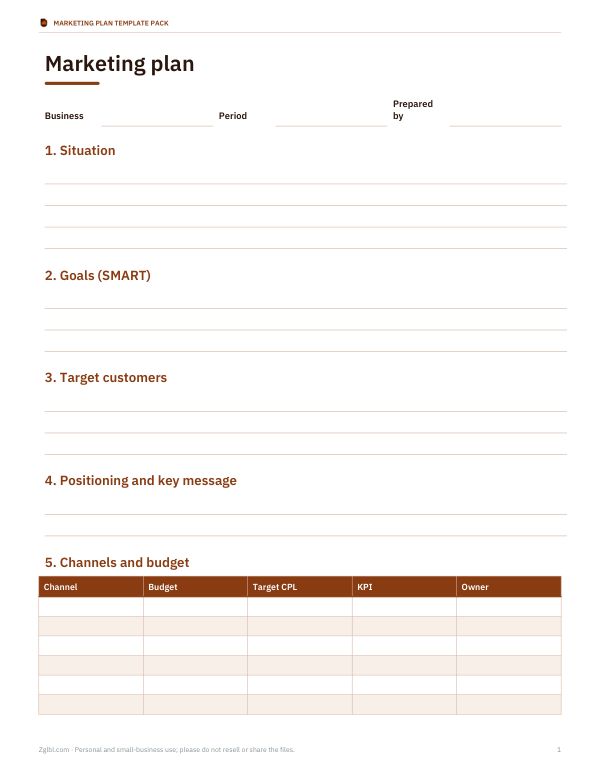
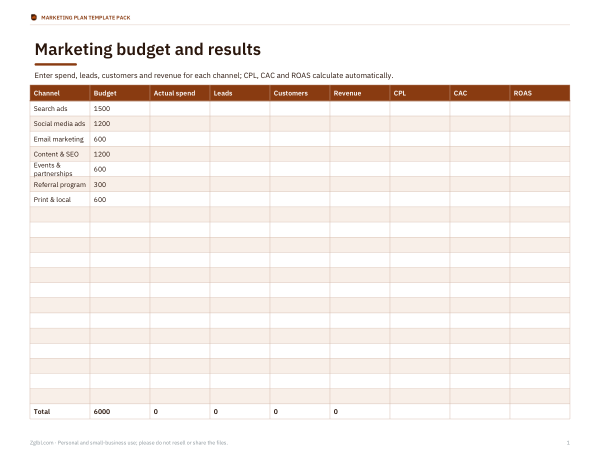
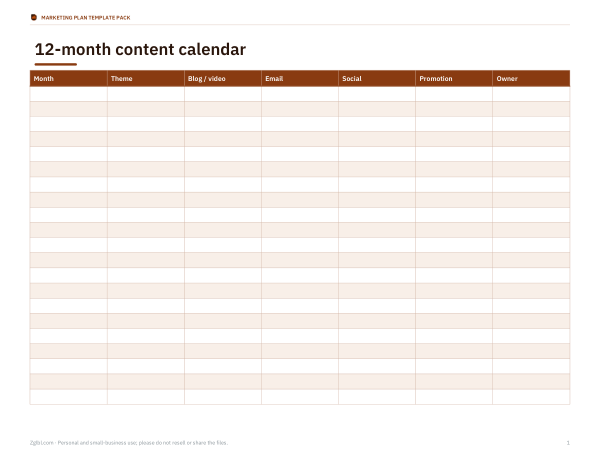
Marketing plan builder
13-week calendar
Marketing Plan Template Pack
Editable marketing plan document, a marketing budget workbook with CPL, CAC and ROAS formulas, a 12-month content calendar, a campaign brief template and a monthly KPI report.
- Marketing plan (DOCX/PDF)
- Budget workbook (XLSX)
- Content calendar (PDF/DOCX/XLSX)
- Campaign brief (PDF/DOCX)
- KPI report (PDF/DOCX/XLSX)
Formats: DOCX, PDF, XLSX. Instant download after payment (link valid 72 hours, up to 5 downloads). AI-assisted: the templates were drafted with AI help and reviewed and laid out before publishing.
$4.00 USD, one-time 5 files · about $0.80 each
- Instant download
- 7-day refund
- Secure checkout by Stripe
7-day money-back guarantee. Full refund within 7 days of purchase, even after you download.
Free sample: Campaign Brief (PDF, 56 KB)
Full refund within 7 days — see the refund policy and license.
Free printables
Single sheets you can print right now, no sign-up. The full pack adds every sheet in one download plus the editable files.
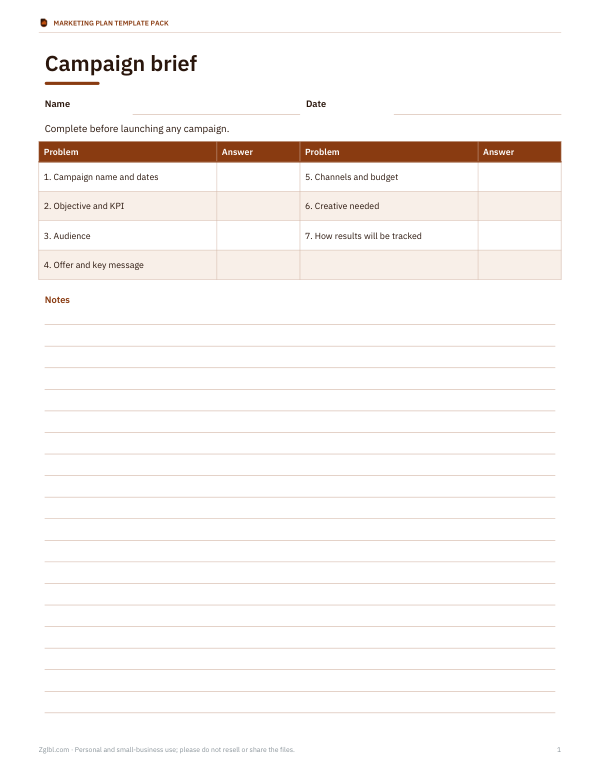 Printable Campaign Brief Worksheet
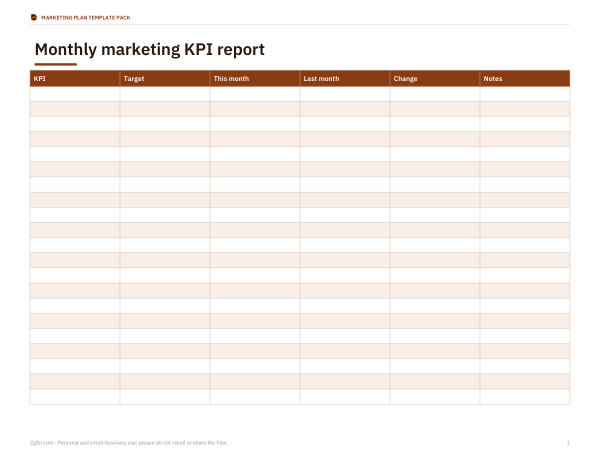 Printable Monthly Marketing KPI Report
The sections of a marketing plan
| Section | What to write |
|---|---|
| Situation | Where the business is now: sales, customers, competitors, strengths and weaknesses |
| Goals | One to three SMART goals: specific, measurable, achievable, relevant, time-bound |
| Target customers | Who you want to reach, what they need and where they spend time |
| Positioning | Why customers should choose you — one clear message |
| Channels and budget | Where you will reach customers and how much each channel gets |
| KPIs | The numbers that show whether each channel works |
| Calendar | What happens each week or month |
| Review | When and how you will check results and adjust |
A one-page plan that everyone reads beats a long document that nobody opens.
Setting SMART goals
A goal like “get more customers” can’t be measured. “Book 180 tune-ups between April and June” can. Start from a business outcome — revenue, bookings, sign-ups — then work backwards: if 25% of leads become customers, 180 customers need about 720 leads. The builder does this in reverse: from your budget and target cost per lead, it estimates leads and customers so you can check whether the goal is realistic.
Worked example
A bike repair shop has $6,000 for a quarter. It splits the budget across search ads, social ads, email, content, a community event, a referral program and local print, with target costs per lead from $8 for email to $40 for events. The plan estimates about 285 leads; with a 25% conversion rate that is roughly 71 new customers at about $84 each, and first-purchase revenue near $6,800. That falls well short of the 180-customer goal — so the owner can raise the budget, shift money to the cheapest channels, improve conversion or adjust the goal before spending a cent.
Choosing channels
- Go where your customers already are: local searches for services, social platforms for visual products, email for repeat buyers.
- Start with two or three channels you can run well rather than seven done badly.
- Keep 10–20% of the budget for testing new ideas.
- Use the channel’s KPI to judge it, then move money from weak to strong channels monthly.
- Count your time as a cost — content and social media are rarely free.
Measuring results
| Metric | Formula |
|---|---|
| Cost per lead (CPL) | Channel spend ÷ leads |
| Conversion rate | Customers ÷ leads |
| Customer acquisition cost (CAC) | Total marketing spend ÷ new customers |
| Return on ad spend (ROAS) | Revenue from ads ÷ ad spend |
| Customer lifetime value (CLV) | Average purchase × purchases per year × years as customer |
A cost per customer higher than the first purchase can still be worth it if customers come back — compare CAC with lifetime value, not just the first sale.
Knowing your customer
| Question | Why it matters |
|---|---|
| Who buys, and who decides? | A parent may buy a bike repair for a teenager — reach the decider |
| What problem are they solving? | Your message should name the problem in their words |
| Where do they look for solutions? | Search, friends, social media, local signs — this picks your channels |
| What stops them buying? | Price, trust, time — address the objection directly |
| What makes them come back? | Loyalty turns one sale into many and lowers CAC |
Talk to five recent customers before writing this section; their answers are worth more than any assumption.
Writing a clear positioning statement
A simple formula works for most small businesses: for [target customer] who [need], [business] is the [category] that [key benefit], unlike [alternative], because [reason to believe]. For the bike shop: for commuters who can’t be without their bike, Riverside Bike Repair is the repair shop that fixes most bikes the same week at a fixed price, unlike dealers with long waits, because certified mechanics triage every bike on arrival. Once written, use the same message in ads, on the website and at the counter.
Common marketing plan mistakes
- Goals without numbers or deadlines.
- Spreading a small budget across too many channels.
- No tracking — if you can’t tell where customers came from, you can’t improve.
- Copying a competitor’s plan without knowing whether it works for them.
- Never reviewing: a plan should change as results come in.
The 90-day calendar
Planning a quarter at a time keeps the plan current. Put fixed dates in first — holidays, product launches, events — then spread campaigns so something is always running, schedule mid-quarter and end-of-quarter reviews, and leave a couple of weeks open for opportunities. The calendar in the builder is editable and exports with the plan.
What’s in the template pack
- Editable marketing plan document (Word) with guidance in every section
- Marketing budget workbook with channel split, CPL, CAC and ROAS formulas
- 12-month content calendar spreadsheet
- Campaign brief template
- Monthly KPI report template
The builder is free; the pack is a one-time download.
Privacy
Your plan stays in your browser; download or print it to keep it.
Frequently asked questions
What should a marketing plan include?
Situation, goals, target customers, positioning, channels and budget, KPIs, a calendar and a review process.
How much should I spend on marketing?
It varies widely by industry and stage; start from your goals and target cost per customer.
What is a SMART goal?
Specific, measurable, achievable, relevant and time-bound.
What is CAC?
Customer acquisition cost — marketing spend divided by new customers.
How do I estimate cost per lead before I start?
Use past results, small test campaigns or industry benchmarks, then replace them with your real numbers after a few weeks.
How often should I review the plan?
Monthly for channel results, quarterly for the whole plan.
Can I use this for a startup or side business?
Yes — start with a small budget, two or three channels and a single measurable goal.
Is my plan saved?
No — download the text or CSV, or print it.